
Do You Really Need a Permit to Replace an Existing Fence in Ballwin, MO?
Talk Through Your Wall's Condition
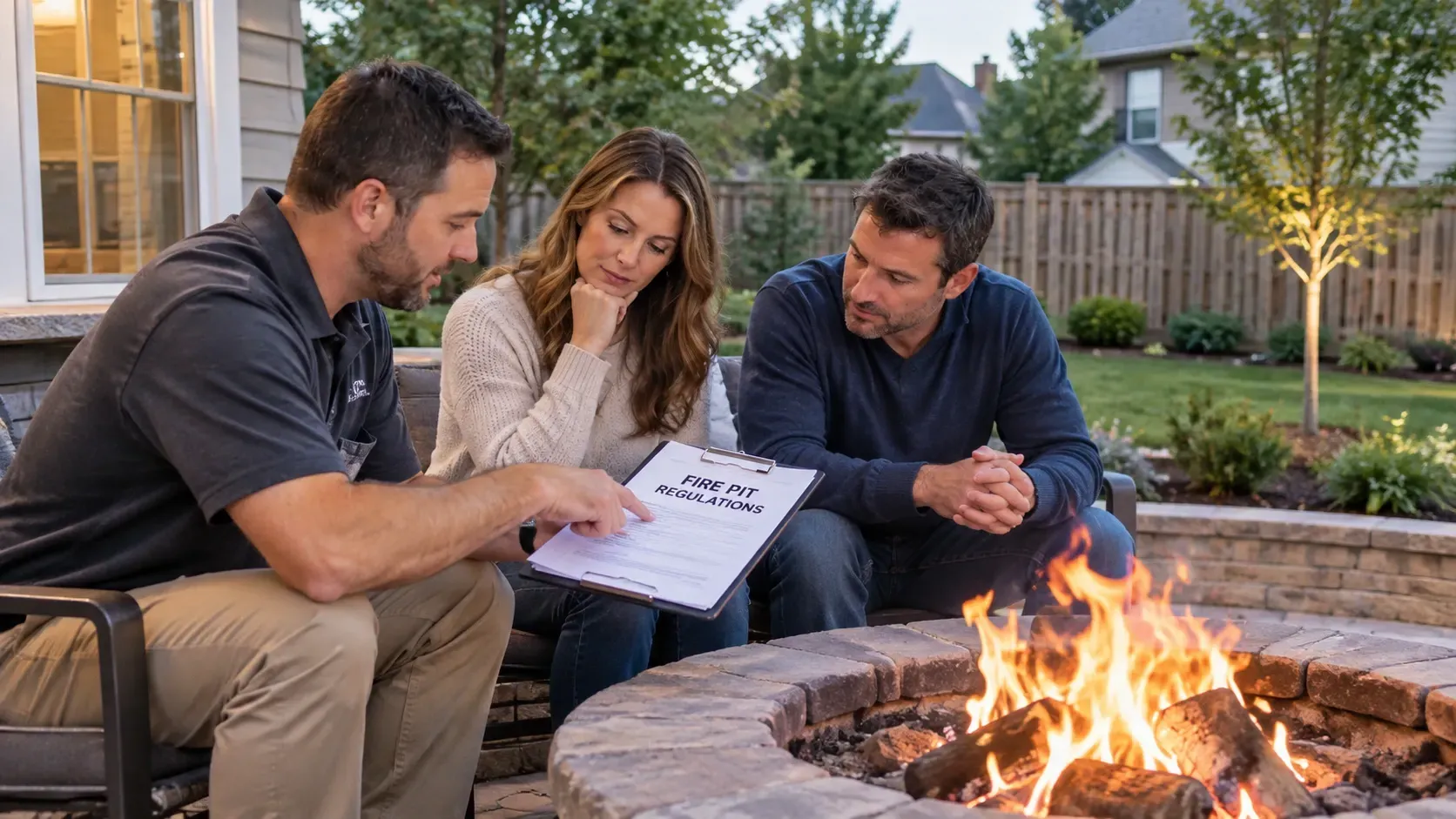
Table of Contents
- Introduction
- Recreational Fire Versus Open Burning
- Who Actually Regulates Your Wood-Burning Fire Pit
- Built-In Versus Portable Fire Pits Are Different Questions
- Setbacks, and Why We Will Not Print the Number
- What Goes Wrong on a Paver Patio
- Fire Pit Design Mistakes We See Most
- Conclusion
- Ask About Fire Pit Placement During Your Design
- Frequently Asked Questions
Key Takeaways
- The same pit can be legal with firewood and illegal with a pile of brush.
- Two authorities govern this, and most people only call one of them.
- A built-in pit is a permanent structure, which brings zoning into it.
- Pavers under sustained direct flame can spall, crack and discolor.
- Wood-burning under a pergola is the plan we talk people out of most.
Introduction
Generally yes, with real conditions attached, and the first is which category you are in, because a wood-burning fire pit is usually treated as a recreational fire rather than as open burning, and those two sit under different rules, which is why the fire pit surrounds we build get designed around clearances from the first sketch.
Most of the trouble we see is not people breaking rules on purpose. It is people who asked one authority, got a yes, and assumed that was the whole answer.
Recreational Fire Versus Open Burning
This is the distinction that explains almost everything, and hardly any homeowner has heard of it.
Open burning means getting rid of material by setting fire to it: yard waste, brush piles, construction offcuts, leaves. It is heavily restricted nearly everywhere, it often needs its own permit, and it is frequently seasonal.
A recreational fire means a small contained fire for warmth, cooking or company, burning clean dry firewood. That is the category a backyard fire pit normally falls into, and it is the reason backyard fires are generally allowed at all.
What usually decides which one you are having:
- What you are burning. Firewood, or waste material you wanted gone
- How big it is. Recreational fire definitions typically cap the size
- Whether it is contained, in a pit, ring or purpose-built structure
- What it is for, which is the part that sounds subjective and mostly is not
Here is the practical version. The same wood-burning fire pit can be perfectly legal on Friday evening with a few splits of oak in it and a violation on Saturday morning with the hedge trimmings in it. Nothing about the structure changed. The category did.
Worth saying plainly: burning treated or painted lumber, pallets, trash, leaves or anything with a finish on it is typically prohibited, and it is also genuinely bad for whoever is sitting around it and for the neighbors downwind. We would skip it on the smell alone.
Who Actually Regulates Your Wood-Burning Fire Pit
Two bodies, usually, and people reliably call only the first.
The municipality handles zoning, structures, nuisance provisions and in some cases the fire code as adopted locally. This is the one everybody thinks of.
The fire protection district is the one that gets missed. Missouri communities are commonly served by a fire protection district as well as a city, and the district has its own rules about recreational fires and its own authority to turn up and require that one be put out. District boundaries do not always match city limits, so your mailing address is not a reliable guide to which one covers you. Find out which district serves your parcel and call them too.
Two more that can override both:
- Burn bans and air quality advisories, which are temporary, which are issued at short notice, and which apply no matter how compliant your pit is
- Your HOA or subdivision indenture, which can prohibit open flame outright on a property where the city is perfectly happy
And a fifth consideration that is not really a regulator but behaves like one. Nuisance complaints. Many ordinances carry a nuisance provision that has nothing to do with setbacks at all, so a fire that meets every dimensional requirement can still become a problem if the smoke is going through a neighbor's open window every weekend. In a subdivision with houses close together, that is the most likely source of a complaint by a wide margin.
Built-In Versus Portable Fire Pits Are Different Questions
This one matters for us specifically, because it is the line between something you buy and something we build.
A portable steel bowl is personal property. You put it down, you move it, nothing about it is permanent. Codes generally treat it accordingly.
A built-in masonry fire pit is a permanent structure, and permanent structures are precisely what zoning ordinances exist to regulate. That can bring in:
- Setbacks from property lines, dwellings and other structures
- Easement restrictions, since a permanent structure generally cannot go in a utility easement at all
- A permit, in some jurisdictions, depending on size and construction
Which means the siting decision is not one you get to revisit. Moving a portable pit takes two people and a wheelbarrow. Moving a built-in one is a demolition. That is why we would rather have the clearance conversation at the design stage than find out afterward.
And an honest word on this. On a tight lot, a portable pit is sometimes the right answer, and we would rather tell you that than build something handsome that has to come out. The same goes for the direction we point you: if the real goal is fire under a covered space, that is a different product entirely, which section six gets to.
Setbacks, and Why We Will Not Print the Number
Every version of this question has a distance attached to it. We are not giving you one.
Clearance requirements exist for two physical reasons: radiant heat, which can ignite nearby combustible material without any flame touching it, and ember travel, which is what actually starts most unintended fires from a backyard pit. Both scale with the fire's size and with wind.
The reason a number here would be useless is that codes measure differently. Depending on the jurisdiction, the required clearance may be measured to the property line, to the dwelling, to any structure, to a deck, to an overhang, to a fence, or to combustible vegetation, and the figure often changes depending on whether the pit is portable or permanent.
We are not printing a distance here, for the same reason we did not print height figures in our corner-lot fence post: it comes from the ordinance your municipality and fire district currently have adopted, and we serve eight towns with eight sets of them.
What to ask instead, of both authorities:
- What clearance is required for a recreational fire?
- Measured from what, to what?
- Does a permanent built-in pit have different requirements from a portable one?
- Is there a maximum size for a recreational fire?
- Do I need a permit for a permanent fire feature?
- Are there hours, or conditions when fires are not allowed?
Then there is the requirement no code contains. Where does the smoke go? Work out your prevailing wind, look at where the neighbor's bedroom window is, and look at your own covered seating. A pit that satisfies every dimension on paper and sits upwind of the patio you actually use is a pit you will stop lighting.
What Goes Wrong on a Paver Patio
Now the part that is ours rather than the city's, because a fire pit on a hardscape has its own problems.
Heat and concrete pavers do not get along indefinitely. Sustained direct flame contact causes spalling, where the face flakes away, plus discoloration and eventually cracking. A fire pit set straight onto a finished paver patio with nothing between the fire and the surface is a patio with a scorched hole in the middle of it in a few seasons.
What we do about it:
- A steel fire ring insert inside the masonry, so the block is never taking direct flame and the expansion and contraction cycle happens against steel
- Appropriate materials at the hearth, rather than whatever matches the rest of the patio
- A proper base, built for the load, since a masonry pit is considerably heavier than the furniture around it
- Drainage that works, because a pit sunk below grade collects water, and water plus a Missouri freeze-thaw winter takes apart anything it gets into
Seat walls are worth planning at the same time. Our own description of this work notes that a fire pit area may need them, and they do two jobs: they fix the usable radius so furniture is not creeping inward, and they keep people at a sensible distance without anybody having to police it. The seat walls go in as part of the patio rather than as an afterthought.
One sizing point people miss. Design the patio for where the chairs end up, not where you draw them. Everyone pulls seating toward the fire as the evening cools. If the patio is only as big as the plan, the furniture finishes the night inside the clearance you carefully worked out.
Fire Pit Design Mistakes We See Most
In rough order of how often we have to talk somebody out of them.
- Under a pergola or covered patio. This is the big one. Wood-burning under any overhead structure is the plan we argue against most, and we will not build it. Embers rise. If you want fire under cover, that is a different product and a different conversation.
- Hard against the house or the deck. Decks are the worst of it, because they are combustible, they are often elevated over an air gap, and embers find the gap.
- Tight to the fence, yours or the neighbor's, which is both a clearance problem and a good-relations problem.
- Under low branches. Look up before you site it, and look up again in five years when the tree has grown into the space.
- Sited for the view rather than the wind, which produces a beautiful pit nobody can sit downwind of.
- Built over a utility easement, which can be dug up at any point by somebody with every right to do it.
- No hose, extinguisher or water source within reach, and no plan for ash. Hot ash in a plastic bin inside a garage is a genuinely common way to lose a garage. Metal container, outside, well away from anything.
If what you actually want is flame near a covered cooking area, the answer is usually a gas feature rather than wood, and that changes who does the work. As our Wentzville permit post puts it, gas and electrical connections belong to appropriately licensed trades. We build the masonry, the built-in grills surround and the patio around it. We do not run gas lines, and anybody who offers to do both without the licensed trade involved is somebody to walk away from. The permit questions around built-in gas are worth reading before you commit to that route.
Conclusion
Before a wood-burning fire pit gets built, call two numbers: your municipality and the fire protection district covering your address. Ask what clearance a recreational fire needs and what it is measured to, and ask whether a permanent pit is treated differently from a portable one. Then site the thing for the wind rather than the view. Everything after that is construction, and construction is the easy part. Fire pits that get taken out early are almost never badly built. They are badly placed.
Ask About Fire Pit Placement During Your Design
Bring us the question before the shovel comes out. Every project starts with a free consultation at your property and an honest assessment with no obligation, which is the right point to work out clearances, wind and where the smoke goes. Buerck Wallscapes is a locally owned hardscaping contractor in Wentzville serving
Wentzville, Lake St. Louis, Wildwood, Ballwin, Chesterfield, Creve Coeur, Ladue and Kirkwood across St. Charles County and west St. Louis County. Satisfaction guaranteed, and if something falls short we will work to make it right. Talk to us about
hardscape design on (636) 332-1836, email greg@buerckstl.com, or
send us photos of the spot. Monday to Saturday, 8am to 5pm.
Frequently Asked Questions
Are backyard fire pits legal in Wentzville, MO?
Generally yes, as a recreational fire rather than open burning, provided clearances are met and no burn ban is in effect. Confirm the specifics with the municipality and with the fire protection district covering your address, since both have a say.
What is the difference between a recreational fire and open burning?
Open burning disposes of material such as brush, leaves or construction waste and is heavily restricted. A recreational fire is small, contained and burns clean firewood for warmth or cooking. The category depends on fuel, size and containment.
Do I need a permit for a built-in fire pit?
Possibly. A permanent masonry pit is a structure, so setbacks, easements and sometimes a permit apply, where a portable bowl usually avoids all three. Ask your municipality specifically about a permanent fire feature.
Can a fire pit damage a paver patio?
Yes. Sustained direct flame causes spalling, discoloration and cracking in concrete pavers. A steel fire ring insert, suitable hearth materials and a properly built base prevent it, which is why the pit should be designed with the patio.
Can I put a fire pit under a pergola?
Not a wood-burning one. Embers rise, and overhead structures are combustible. If you want flame under a covered area, a gas feature is the route, and the gas connection itself belongs to an appropriately licensed trade.