
Is It Legal to Build a 6-Foot Privacy Fence on a Corner Lot in Chesterfield, MO?
Talk Through Your Wall's Condition
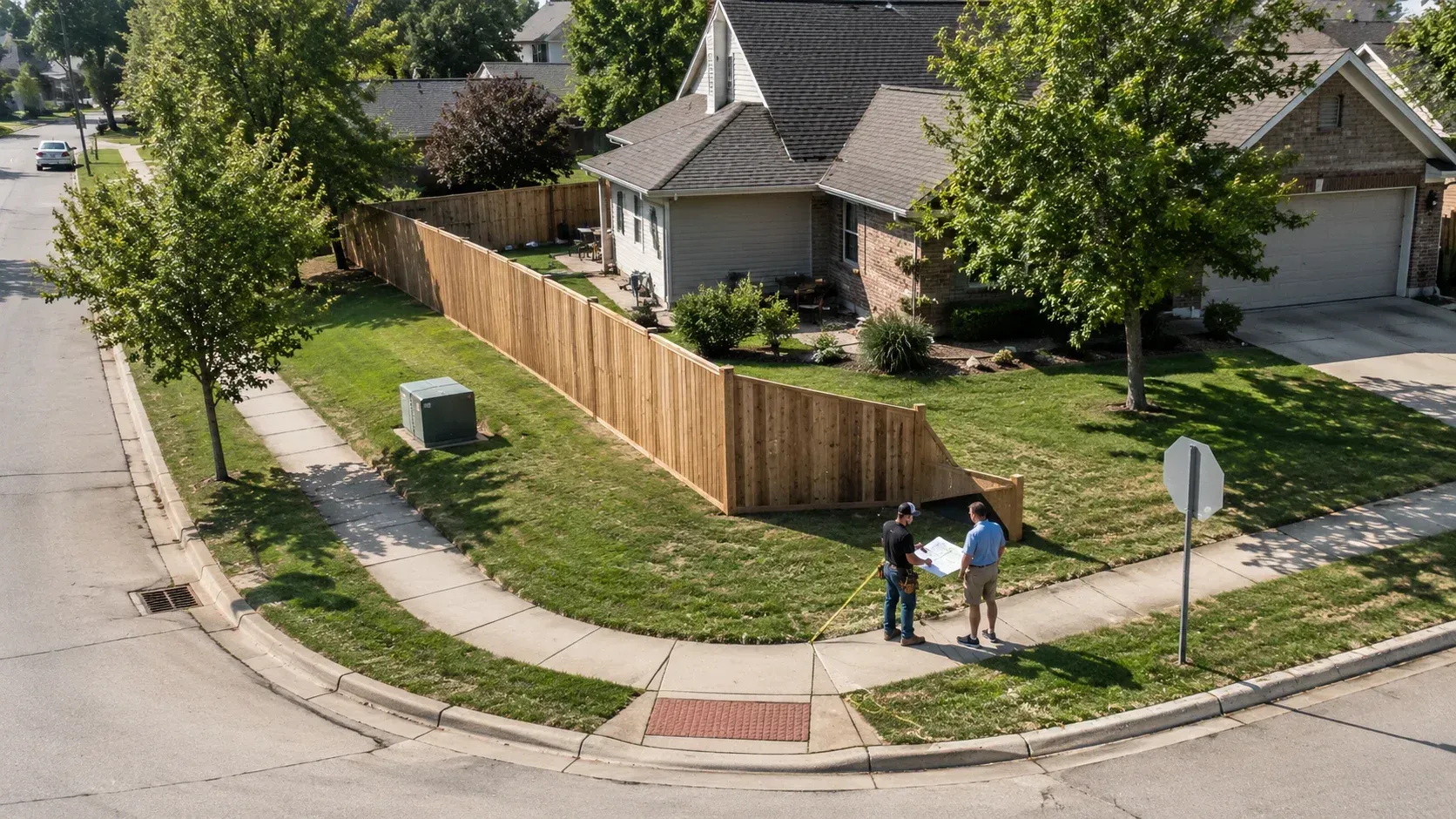
Table of Contents
- Introduction
- The short answer
- The sight triangle, and why it exists
- Corner lots have two front yards
- The height rules that usually apply
- Easements are the other invisible limit
- Find your property line before you find your posts
- What usually needs a permit
- HOA rules can be stricter than the city
- What we check before quoting a corner-lot fence
- Conclusion
- Ask Us to Check Your Sight-Triangle Setback Before Your Fence Quote
- Frequently Asked Questions
Key Takeaways
- A 6-foot privacy fence is usually allowed on most of a Chesterfield corner lot, but not at full height near the street intersection.
- The restriction is a sight triangle: a corner area where obstructions above a low height are prohibited so drivers can see approaching traffic and pedestrians.
- Corner lots are typically treated as having two front yards for zoning purposes, and front yards usually carry a lower height limit than side and rear yards.
- Utility and drainage easements can prevent a fence entirely, or leave you paying to remove it if the utility needs access.
- The property line is not where the old fence is. A survey or located pins is the only reliable answer.
Introduction
A 6-foot privacy fence on a Chesterfield corner lot is usually legal across most of the property, but generally not at full height in the corner nearest the intersection. Municipalities restrict what can sit inside a sight triangle near street corners so drivers can see oncoming traffic, cyclists, and children, and a solid 6-foot fence is exactly the kind of obstruction those rules exist to prevent. So the honest answer is that the same fence can be entirely compliant along your rear line and non-compliant twenty feet away, and that is the wrinkle we plan around on every corner-lot fence installation we quote.
We build fences, we do not administer zoning, so treat this as a map of the questions rather than a ruling on your lot. Chesterfield's requirements differ from Wentzville's and from every other town we serve.
Here is what governs a corner lot, in the order it will affect your design.
The Short Answer
For most corner-lot homeowners in Chesterfield:
- Rear and interior side yards: a 6-foot privacy fence is typically permitted
- Street-facing yards: a lower height limit usually applies, and a corner lot generally has two of them
- Inside the sight triangle: height is restricted to something low enough to see over, regardless of what the rest of the lot allows
- Inside a utility or drainage easement: a permanent fence may not be allowed at all
- A permit: commonly required, and separate from any HOA approval
- The binding answer: comes from Chesterfield's planning or zoning department, not from a blog
We are not printing height figures or triangle dimensions here, because those come from the ordinance your municipality currently has adopted and a stale number would be worse than none.
The Sight Triangle, and Why It Exists
A sight triangle, sometimes called a vision clearance area or corner visibility triangle, is a triangular zone at the intersection of two streets, or at a driveway and a street, measured back from the corner along both lines.
Within that zone, obstructions above a low height are generally prohibited. What counts as an obstruction is broader than people expect:
- Fences and walls
- Hedges, shrubs, and berms
- Signs and mailboxes structures
- Parked trailers and stored materials
- Tree canopy below a certain height, though trunks are often treated separately
The purpose is straightforward. A driver stopping at the corner needs to see far enough down the cross street to pull out safely, and a pedestrian or a child on a bike needs to be visible before they are in the road. A solid fence built to the corner defeats that.
Two practical consequences for a homeowner:
- The restriction applies to the corner area only, so most of your fence is unaffected
- It usually has to be designed around rather than argued about, because the reasoning behind it is safety rather than aesthetics
Corner Lots Have Two Front Yards
This is the single most useful thing to understand, and it catches almost everyone.
For zoning purposes, a yard facing a street is generally treated as a front yard. An interior lot has one. A corner lot has two, because it fronts two streets. That means:
- The area most people think of as their "side yard" along the cross street is often classified as a second front yard
- Front yard height limits are typically lower than side and rear limits
- So the fence line you most want for privacy, along the cross street, may be the one most restricted
This is why two neighbours on the same block can get different answers. The interior lot has one front yard and a straightforward rear-yard fence. The corner lot has two front yards, a sight triangle, and a design problem.
It is also why corner-lot fence quotes are worth getting from someone who has built them before. The layout that satisfies the ordinance while still giving you usable privacy is a design question, not just a materials question.
The Height Rules That Usually Apply
Without giving figures, the pattern in most Missouri municipalities looks like this:
- Front yards: a lower maximum height, often with a requirement that the fence be more open than solid
- Side and rear yards: a higher maximum, which is where 6 feet typically becomes available
- Sight triangles: lower still, low enough to see over from a car
- Along a public sidewalk or right-of-way: a setback may apply, so the fence sits inside your line rather than on it
- Retaining walls with fence on top: combined height is sometimes measured together rather than separately
That last one matters on sloped corner lots, which are common around here. If grade drops across your property and you need a wall to hold it, the wall and the fence above it may be treated as one structure for height purposes. Where that comes up we look at the retaining wall and the fence as a single design rather than two jobs.
Easements Are the Other Invisible Limit
Easements are recorded on your plat and they override your preferences.
- Utility easements grant a utility access across your property. Building a permanent fence inside one is often prohibited, and where it is allowed, the utility can generally remove what it needs to and is not obliged to rebuild it
- Drainage easements exist to move stormwater and cannot be obstructed
- Sidewalk and right-of-way areas are usually not yours to build on, even where the grass looks like part of your lawn
- Sewer laterals and access points need to stay reachable
Get your plat before you plan the fence line. If you do not have a copy, the city or county recorder can usually point you to it. Discovering an easement after the posts are set is one of the more expensive ways to learn this.
Find Your Property Line Before You Find Your Posts
The most common fence dispute we see has nothing to do with the city.
- An existing old fence is not evidence of the property line. Fences get built in convenient places and drift over decades
- A hedge, a tree line, or a mowing pattern is not the line either
- The reliable answers are a current survey, or located and verified survey pins
- Building even slightly onto a neighbour's land can mean moving a finished fence at your cost, and in some circumstances long-term encroachment raises harder legal questions
- Where the line is genuinely uncertain, a conversation with the neighbour before construction is worth more than one afterward
There is also a courtesy dimension that saves real money. Telling your neighbour what you plan, where the line is, and which side faces out prevents the disputes that end with someone calling code enforcement.
And before any post hole is dug, call 811 for utility locates. That is free, it is required, and hitting a buried line is both dangerous and expensive.
What Usually Needs a Permit
Fence permits are common, and they exist partly so someone checks the things above before you build.
Typically reviewed:
- Height, by yard classification
- Location relative to property lines, setbacks, and the right-of-way
- Sight triangle compliance on corner lots
- Materials, in some jurisdictions
- Which side the finished face points, since many ordinances require the finished side to face outward
The application usually wants a site plan showing the fence line, heights, and gates. That is straightforward to produce when the property line and easements are already established, and painful when they are not, which is another argument for doing those first.
HOA Rules Can Be Stricter Than the City
If your corner lot is in a subdivision with an association, its rules apply on top of the ordinance.
- HOA restrictions are private agreements, enforceable against you, and frequently stricter than code
- Common restrictions cover materials, colour, style, height, and whether privacy fencing is permitted at all
- Many associations require plan approval before construction, on their own timeline
- City approval does not override an HOA restriction, and HOA approval does not satisfy the city
Both need clearing. On corner lots especially, associations sometimes have specific rules about street-facing fence lines, because those are the ones visible from two directions.
What We Check Before Quoting a Corner-Lot Fence
When we come out to a corner lot, the walk is different from an interior lot:
- Where both street frontages are, and which yards are therefore front yards
- Where the sight triangle falls, and how the design works around it
- Where the property line actually runs, and whether pins are locatable
- What the plat shows for easements and right-of-way
- The grade, and whether a retaining wall is part of the answer
- Where gates need to be for mowers, trailers, and trash cans
- What the neighbours' fences do, since matching or meeting them cleanly matters
Then we tell you what we think is buildable, and what needs confirming with Chesterfield before we quote it. We would rather find the sight triangle at the estimate than at the inspection. You can see finished work in our gallery, and our fencing overview covers the styles we build.
Conclusion
A 6-foot privacy fence is usually available across most of a Chesterfield corner lot and usually not at full height near the intersection. The two rules doing that work are the sight triangle and the fact that a corner lot generally has two front yards rather than one, which reclassifies the very fence line you probably most want for privacy.
Three things to settle before you commit to a design: what Chesterfield allows by yard classification and inside the sight triangle, where your property line actually is, and what your plat shows for easements. Those answers shape the layout, and a corner-lot fence designed around them looks deliberate rather than compromised.
Ask Us to Check Your Sight-Triangle Setback Before Your Fence Quote
If you are planning a fence on a corner lot in Chesterfield or anywhere across
our service area, let us walk it with you first. We will look at both frontages, the grade, where the sight triangle falls, and what the layout can realistically do, then tell you what needs confirming with the city. Buerck Wallscapes offers free consultations and stands behind its work with a satisfaction guarantee. Call Greg at (636) 332-1836, Monday to Saturday, or
get in touch. Bring your plat and any survey you have, because those two documents answer more questions than a tape measure will.
Frequently Asked Questions
Can I build a 6-foot privacy fence on a corner lot in Chesterfield?
Usually across most of the lot, but generally not at full height near the street intersection. Sight triangle rules restrict height in the corner area, and corner lots typically have two front yards, which often carry lower limits than rear yards.
What is a sight triangle?
A triangular area at a street corner or driveway where obstructions above a low height are prohibited so drivers can see approaching traffic and pedestrians. It applies to fences, walls, hedges, berms, and stored items alike.
Why does a corner lot have two front yards?
Because zoning generally classifies any yard facing a street as a front yard, and a corner lot fronts two streets. The side facing the cross street is often treated as a second front yard, with the lower height limit that implies.
Do I need a survey before building a fence?
It is strongly advisable. An existing fence, hedge, or mowing line is not evidence of the boundary. A current survey or located pins prevents encroachment, which can mean moving a finished fence at your own cost.
Can I build a fence inside a utility easement?
Often not, and where permitted the utility can generally remove what it needs for access without rebuilding it. Check your plat for easements before finalising the fence line, since this is not discretionary.